
Beyond the phone call: How Leaping’s voice agents handle calls and texts
Leaping AI now combines AI-powered phone calls and text messages in one platform. Learn how AI SMS and iMessage workflows handle appointment confirmations, reminders, and follow-ups automatically.
4
min read
Voice AI Technology Explained
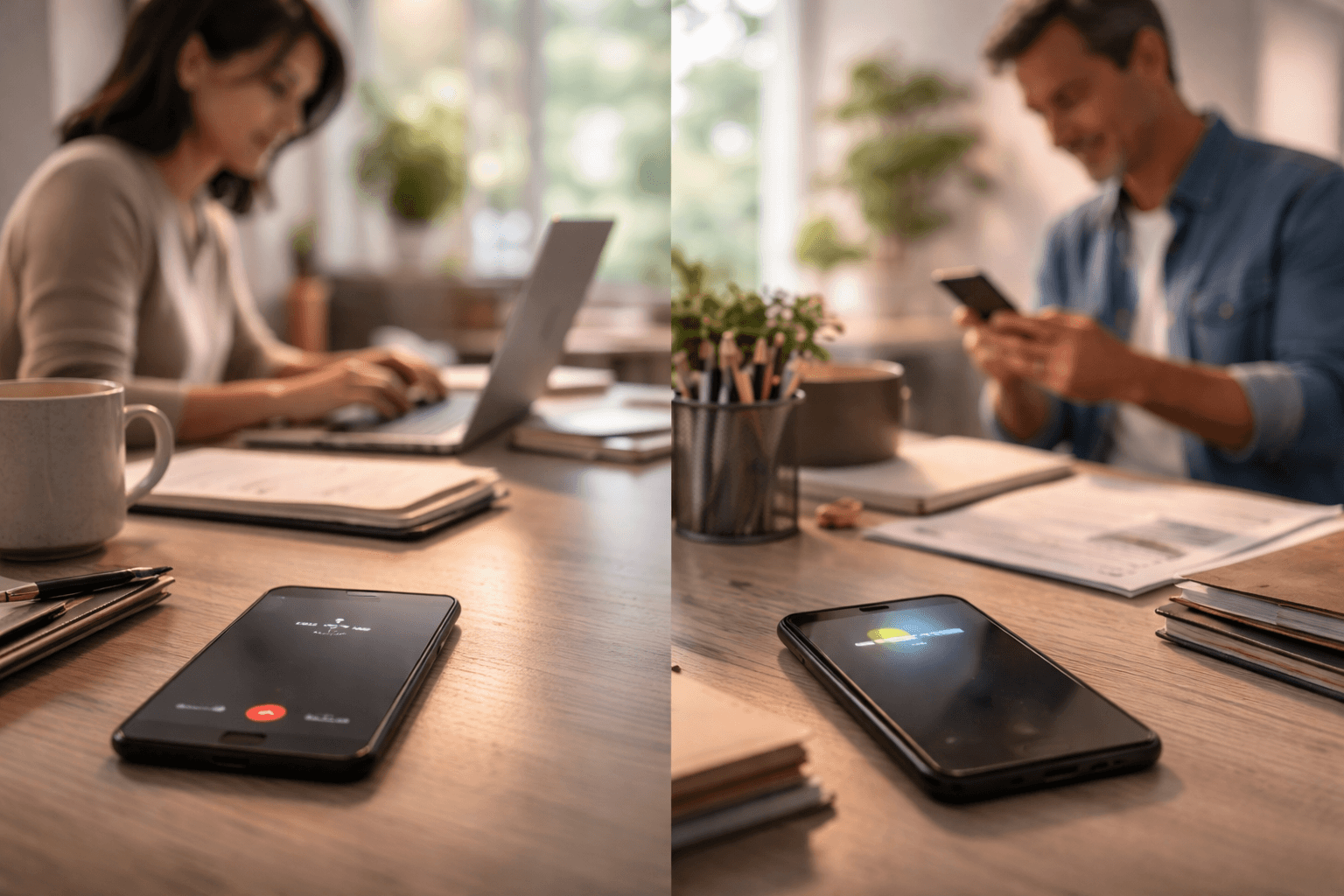
A customer calls. Your voice AI agent answers the call. The appointment is confirmed. Job done, right?
Not always. Sometimes the customer does not pick up. Or they need a reminder before their appointment. Or a follow-up after the job. The phone call is just one part of the conversation. The rest happens over text.
And we're happy to announce that Leaping AI now handles both. Here is what that means for your business.
TLDR
Leaping AI has launched AI-powered texting, supporting both iMessage and SMS channels
Key use cases include appointment confirmations, payment reminders, and follow-ups when a call goes unanswered
Users can build automated workflows to control when and how messages are sent
SMS has a 98% open rate versus 20-28% for email, making it one of the highest-engagement channels available
Combined voice and text coverage means no customer interaction falls through the gaps
What Leaping AI now offers
Leaping AI has always been built around voice. The platform deploys human-like AI voice agents that handle inbound and outbound calls, qualify leads, book appointments, and transfer to human agents when needed. It connects directly to your CRM, syncs data automatically, and keeps improving through self-analysis after every call.
The new AI texting feature extends that capability into messaging. Users can now send automated, AI-powered messages through both iMessage and SMS, triggered by specific events in their workflows. Both channels are fully live.
This is the natural extension of what building an effective AI call center actually requires: coverage across every channel your customers use, not just the phone.
Why a text matters as much as the call
Phone calls are high-intent and immediate. But they have a built-in limitation: the other person has to pick up.
According to research from Sakari, SMS achieves a 98% open rate and a 45% response rate, compared to roughly 6% for email. Most texts are read within three minutes of delivery. No other channel comes close to that kind of immediacy.
For businesses running AI voice agents, this creates a practical opportunity. When a call does not connect, a text can. When an appointment needs confirming, a text is faster and less disruptive than a call. When a payment is overdue or a follow-up is needed, a text gets read almost every time.
AI texting works alongside the voice agent, making it more complete.
The three core use cases for automated texts
1. Appointment confirmations after a missed call
Your AI voice agent calls a lead. They do not answer. Historically, that is where the interaction ends until someone manually follows up.
With AI SMS, the system sends a text immediately after the missed call, confirming the appointment, sharing the details, and giving the customer an easy way to respond or reschedule. No lead sits in limbo. No manual follow-up required.
2. Appointment and payment reminders
No-shows cost real money. So do late payments. Automated reminders sent via SMS before an appointment or after an invoice is issued are among the highest-ROI touchpoints a business can run.
Research found that 83% of businesses that text their customers have incorporated AI into their SMS strategy, and 81% report that AI has enhanced their results. The shift is already well underway across industries, from home services and healthcare to real estate and insurance.
3. Follow-ups of any kind
Post-service check-ins, satisfaction messages, re-engagement of past customers, renewal reminders, all of these can be automated through Leaping AI's texting workflows. Define the trigger, write the message, set the timing, and the system handles the rest.
How the workflow system works
Leaping AI users build workflows that determine when and how messages are sent. This gives teams full control over the logic without requiring technical expertise to configure.
A simple workflow might look like this:
Trigger | Action |
Outbound call goes unanswered | Send SMS with appointment details within 2 minutes |
Appointment confirmed | Send iMessage reminder 24 hours before |
Appointment completed | Send SMS follow-up after 48 hours |
Invoice sent, unpaid after 7 days | Send payment reminder via SMS |
Workflows can be adapted for any business model or customer journey. The combination of iMessage and SMS support means the message reaches the customer on the channel they actually use, without requiring your team to manage it manually.
How voice and text work together
Leaping AI's voice agents and AI texting are designed to complement each other across the full customer journey. Here is what that looks like in practice:
Inbound call: AI voice agent answers, qualifies, and books an appointment. Confirmation sent via SMS automatically.
Outbound campaign: AI agent calls leads. For those who do not answer, an AI text follows within minutes. Responses are tracked and fed back into the CRM.
Pre-appointment: Automated reminder sent via iMessage or SMS based on customer preference.
Post-service: Follow-up text sent on a set schedule. No manual action from your team.
Missed payment: Payment reminder triggered automatically from your billing system integration.
This is what reducing missed calls and unanswered interactions actually requires — not just better call handling, but a system that keeps the conversation going through whatever channel works.
What this means for enterprise and high-volume teams
For mid-market and enterprise businesses running large contact center operations, the combination of AI voice and AI SMS addresses a structural gap that most platforms leave open.
Voice AI handles the calls. But customer communication does not only happen on calls. Confirmation sequences, reminder chains, and follow-up flows have traditionally required separate tools, separate teams, or manual processes to manage.
Leaping AI now consolidates both into a single platform. Call recordings, transcripts, CRM sync, and now SMS workflows all live in one place. Teams working across enterprise customer service environments no longer need separate systems to manage voice and text communication.
For businesses that prioritize security and compliance, this matters even more. Leaping AI meets GDPR, SOC 2, and HIPAA requirements, making it one of the strongest options for teams that need a secure voice AI infrastructure and now, secure AI messaging alongside it.
Who benefits most
AI-powered texting with Leaping AI is well-suited for businesses that:
Run outbound call campaigns and need automatic follow-up when calls go unanswered
Have high appointment volumes with recurring no-show or cancellation rates
Handle post-service follow-ups manually today, and want to automate them
Operate in industries where payment reminders and renewal notices are part of the workflow
Already use Leaping AI's voice agents and want their contact coverage to extend beyond the call
Industries currently using Leaping AI include home services, travel, insurance, real estate, home remodeling, property management, medical practices, and legal, all sectors where timely follow-up and appointment management directly affect revenue.
A complete call answering and messaging system
A phone call answered is a great start. But customer communication does not begin and end with one interaction. Confirmations, reminders, follow-ups, and re-engagement are the threads that hold the customer relationship together between calls.
Leaping AI's AI-powered texting closes the gap between what voice agents can do and what customers actually need across the full journey. Voice and text, working together, are automated from a single platform.
Explore how Leaping AI handles voice and text for your business and book a voice AI demo to see it in action.
Related articles

How does AI Call Routing work? A guide
AI call routing uses machine learning & NLP to analyze calls, directing them to the best resource. It reduces wait times, cuts costs, and boosts satisfaction. Discover how it works.
KI-Anrufweiterleitung: So funktioniert intelligentes Routing
Revolutionieren Sie Ihr Call Center mit KI-Anrufweiterleitung. Erfahren Sie, wie intelligentes Routing Wartezeiten verkürzt, Kosten senkt & Kundenzufriedenheit steigert. Jetzt informieren!
" height="40px" id="WAr1m0SbV" width="40px"/></svg>)
" height="36.155776153594424px" id="q7J04lAF0" width="40px"/></svg>)
© 2026 Leaping AI
All services operational.