
Should roofing contractors use an AI answering service? A complete guide
Discover whether roofing contractors should use AI answering services. Learn how voice AI captures emergency calls, qualifies leads, and prevents revenue loss from missed opportunities.
4
min read
Case Studies and Applications
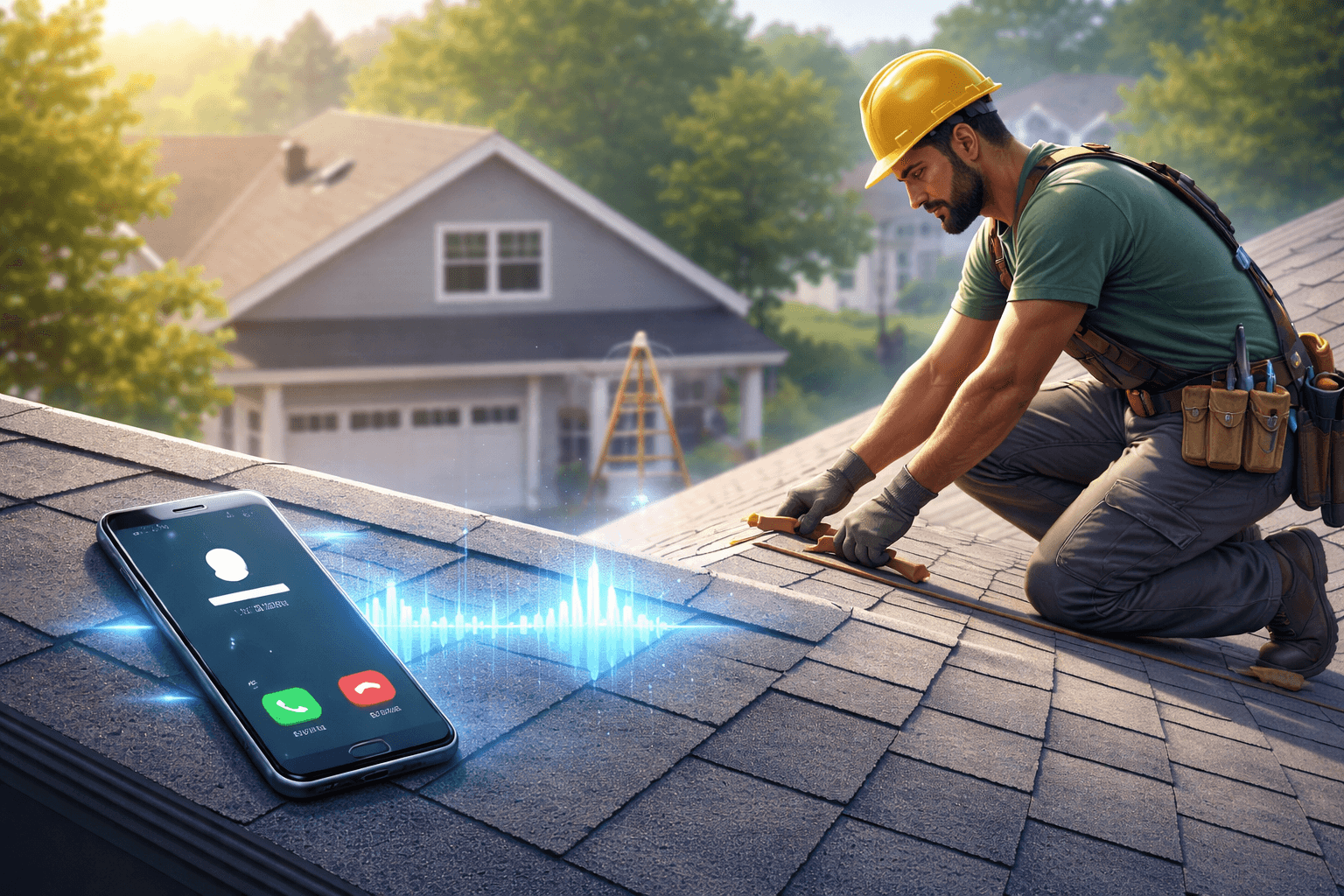
Roofing contractors face a tough reality when it comes to managing incoming calls throughout their workday. When you're on a roof in the middle of a job, answering the phone simply isn't possible, yet that ringing phone could represent a $10,000 roof replacement or an emergency repair that brings premium pricing. The challenge becomes even more frustrating when you realize that homeowners calling about roofing needs rarely leave voicemail. Instead they move down their list to call the next contractor who might actually pick up.
According to research, approximately 27% of all incoming calls go unanswered, which translates directly into thousands of missed opportunities and potentially millions in lost revenue annually.
AI answering service technology solves this fundamental problem by ensuring that every single call gets answered professionally, regardless of whether you're actively working on a roof, meeting with another customer, or simply unavailable after regular business hours.
TLDR
Roofing contractors benefit significantly from roofing contractor AI answering service solutions that handle calls 24/7, qualify leads automatically, and book appointments while crews work on jobs.
According to JobNimbus analysis, missing just two calls weekly at a modest $500 job value costs contractors $52,000 annually in lost revenue.
Roofing emergency call automation captures after-hours inquiries that often come with premium pricing, while voice AI for roofing lead generation qualifies prospects instantly and routes hot leads to sales teams.
Implementation typically requires minimal setup time, with most systems operational within days rather than weeks or months.
Why do roofing contractors miss so many valuable calls?
Roofing work often puts you in a tough spot, either you focus on the job at hand or you stop to answer new calls.
When you're physically on a roof installing shingles, securing flashing, or inspecting storm damage, you simply cannot safely stop what you're doing every time your phone rings.
Common reasons roofing contractors miss calls:
Safety concerns - Answering phones while working at heights is dangerous
Post-storm overwhelm - Call volume spikes dramatically when everyone needs repairs simultaneously
Lean team operations - Small crews have no one available to handle phones while on job sites
After-hours emergencies - Homeowners discover leaks during evenings and weekends
Traditional answering services - Message-taking doesn't capitalize on urgency, driving emergency calls
Understanding complete lead automation for home remodeling businesses reveals how automation prevents revenue loss across all trades.
The result creates a predictable pattern where interested homeowners, faced with voicemail or no answer, immediately move on to the next roofing contractor on their list without giving you a second chance to earn their business.
If you want a broader view of how this is changing across industries, you can explore this breakdown on HVAC technology trends 2026.
What does it cost when roofing calls go unanswered?
Many roofing contractors underestimate the true financial impact of missed calls because they think about each individual missed opportunity in isolation rather than calculating the cumulative annual cost.
The real cost of missed calls:
Scenario | Weekly Loss | Annual Loss |
2 missed calls/week at $500 avg job (50% conversion) | $500 | $26,000 |
3 missed calls/week at $2,500 avg job (50% conversion) | $3,750 | $195,000 |
5 missed calls/week at $10,000 avg job (50% conversion) | $25,000 | $1,300,000 |
Miss just three calls a week, and the impact adds up fast. With an average job value of $2,500 and a 50% close rate, that’s about 1.5 lost jobs weekly, roughly $3,750 in missed revenue every week, or close to $200,000 a year.
And it’s not just one job. Each missed call could have led to repeat work, referrals, and future projects, revenue you never even get the chance to earn.
How does AI answering technology specifically help roofing businesses?
AI voice agents for roofing deliver capabilities that go far beyond traditional answering services or voicemail systems by actually handling complete conversations rather than simply collecting messages for you to return later.
Key AI capabilities for roofing contractors:
Lead qualification questions the AI asks:
What type of roofing issue are you experiencing?
Is this an emergency requiring immediate response?
What's the approximate age and type of your current roof?
What's your timeline for getting the work completed?
Are you getting quotes from multiple contractors?
Smart routing based on answers:
Emergencies → Direct to on-call crew
Non-urgent estimates → Sales team during business hours
Routine inquiries → Scheduled appointments
Real-time appointment booking:
AI accesses your scheduling system instantly
Offers available time slots to homeowners
Locks in appointments without human intervention
Sends automatic confirmations
The appointment booking capability represents a significant advantage, as the AI can access your scheduling system in real-time to offer available time slots and lock in appointments without requiring any human intervention. Homeowners appreciate the immediate scheduling, which feels more professional than leaving a message and waiting hours or days for a callback.
See how to automate canvassing calls for field teams.
Emergency call handling after regular business hours delivers particularly strong value for roofing contractors, as these calls often involve leaks or storm damage where homeowners are willing to pay premium rates for immediate service.
What concerns do roofing contractors have about AI answering services?
Despite the clear benefits, many roofing contractors express understandable hesitation about implementing AI technology to handle their customer calls.
Common concerns and the reality:
Concern | Reality |
Sounds robotic | Modern AI uses natural language processing virtually indistinguishable from human receptionists |
Loses personal touch | Relationship building happens during estimates and jobs, not initial scheduling calls |
Complex technical setup | Works with current phone numbers through simple call forwarding, with minimal setup required |
Too expensive | Monthly cost ($100-$500) vs. annual revenue loss from missed calls ($50,000+) shows clear ROI |
Won't understand customers | Handles interruptions, accents, and colloquialisms gracefully with adaptive responses |
Concerns about AI sounding robotic are mostly outdated. Modern voice systems sound natural and conversational, often close to a human receptionist.
Setup is simpler than most expect. AI answering works with your existing number, forwards calls seamlessly, and usually requires no hardware or complex integration.
If you want to understand the process in more detail, you can read more about implementing voice AI agents for home services.
How do AI voice agents compare to hiring a receptionist?
Choosing between implementing an AI answering service and hiring a human receptionist requires understanding the practical differences.
AI answering service vs. human receptionist:
Factor | Human Receptionist | AI Answering Service |
Annual cost | $30,000-$45,000 (salary + benefits) | $1,200-$6,000 ($100-$500/month) |
Availability | Business hours only, requires breaks, vacation, sick days | 24/7/365, no breaks ever |
Call capacity | One call at a time | Unlimited concurrent calls |
Consistency | Varies by mood, energy, and experience | Identical quality every call |
Setup time | Weeks (hiring, training) | Days (simple configuration) |
Scalability | Must hire more people for growth | Handles volume spikes automatically |
A full-time receptionist typically costs between $30,000 and $45,000 annually when you factor in salary, taxes, benefits, and the space and equipment they require to do their job. This person can generally handle calls during normal business hours, take lunch breaks, call in sick occasionally, and require time off for vacation.
AI answering services, on the other hand, operate 24 hours a day without breaks, sick days, or vacation time, handling unlimited concurrent calls during busy periods without any degradation in service quality. The technology costs a fraction of human staffing, typically ranging from $100 to $500 monthly, depending on call volume and features, which represents roughly 95% cost savings.
However, AI technology does have limitations when compared to experienced human receptionists, particularly in handling highly emotional situations where customers might be upset Learn how voice AI tools reduce handle time while maintaining quality.
What implementation process should roofing contractors expect?
Getting started with an AI answering service for your roofing business typically involves a straightforward setup process that most contractors complete within days.
Week 1: Initial setup
Connect the AI service to your business phone number via call forwarding
Determine routing rules (after-hours only, busy lines, or all calls)
No physical equipment changes required
Week 1-2: Conversation design
Provide information about your roofing services
Share common customer questions
Define service area and typical pricing ranges
AI learns from examples to match your communication style
Week 2-3: Integration
Connect to scheduling and CRM systems (or start with email/text notifications)
Set up automatic appointment booking
Configure call logging and information capture
Week 3-4: Testing and refinement
Review call recordings and transcripts
Analyze what questions customers asked
Adjust responses based on real conversations
Monitor conversion rates and appointment bookings
For contractors using specific platforms, check the best voice AI for Improveit360 integration options.
The learning curve for your team is usually very small. The AI handles customer calls on its own, so your staff only needs to know how to check appointments and view call logs, not learn a whole new system.
Choosing AI answering services for your roofing business
In roofing, the first contractor to answer often wins the job. Missing calls means missing revenue, especially during urgent repairs or peak seasons.
What you get:
Capture every call, even while you’re on-site
24/7 coverage for emergency jobs
Faster lead qualification and routing
Automatic appointment booking
Lower costs than hiring staff
Easy scaling during busy periods
AI answering service handles calls, books jobs, and filters leads in the background, so your team can stay focused on actual roofing work.
Leaping AI is built for roofing and home service businesses, with natural conversations, emergency routing, and seamless scheduling.
Book a voice AI demo with Leaping AI to see how you can capture more leads without missing a call.
Related articles

How home improvement businesses use Voice AI and AI texting to automate growth
Learn how home improvement businesses use Voice AI and AI text messages to automate lead follow-up, appointment scheduling, and customer communication from first enquiry to completed job.
How bath remodeling contractors are automating calls with an AI call center
Discover how bath remodeling contractors are using AI call centers to answer every lead, book more consultations, and stop losing jobs to missed calls. See how Voice AI transforms contractor businesses.
" height="40px" id="WAr1m0SbV" width="40px"/></svg>)
" height="36.155776153594424px" id="q7J04lAF0" width="40px"/></svg>)
© 2026 Leaping AI
All services operational.