
How does AI Call Routing work? A guide
AI call routing uses machine learning & NLP to analyze calls, directing them to the best resource. It reduces wait times, cuts costs, and boosts satisfaction. Discover how it works.
5
Min. Lesezeit
Sprachtechnologie erklärt

A customer calls your support line at 2 a.m., frustrated about a billing issue. In a traditional setup, they would hit a maze of menu options, wait on hold, maybe get transferred twice, and possibly give up. With AI call routing, that same caller gets connected to the right resource in seconds, whether that is an AI voice agent trained on billing queries or a human specialist who is actually available and equipped to help. The difference is not subtle.
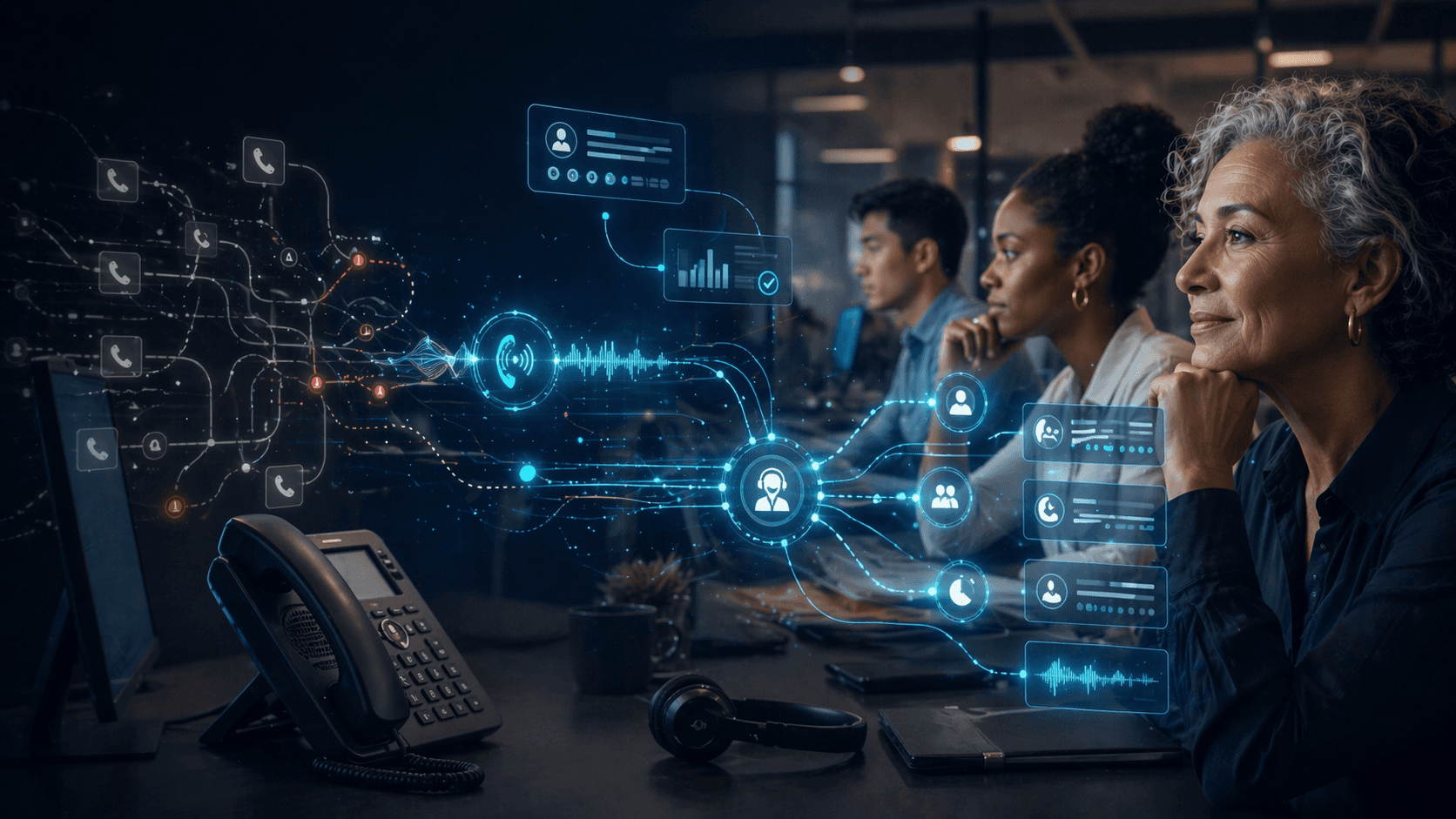
AI call routing uses machine learning and natural language processing to analyze incoming calls in real time and direct them to the most appropriate destination. This is a fundamental change in how call centers operate, moving from rigid menu trees to intelligent, context-aware systems that understand caller intent, emotion, and history before making routing decisions.
Why traditional call routing often fails
Traditional call routing relies on static, rule-based systems like Dialed Number Identification Service (DNIS) or basic Interactive Voice Response (IVR). These systems force callers into rigid, predetermined paths, often failing to address the true complexity of customer needs. The result is a frustrating experience for customers and an inefficient workflow for agents.
These old-school systems operate on simple if-then logic: press 1 for sales, press 2 for support, press 3 for billing. The problem is that customer needs rarely fit into neat categories, and the system has no way to adapt to context, urgency, or individual circumstances. This leads to predictable friction, with customers getting stuck in loops, transferred multiple times, or routed to agents who lack the expertise to help them.
Traditional vs. AI call routing at a glance
Feature | Traditional routing (IVR) | AI call routing |
|---|---|---|
Interaction | Press-button menus (DTMF) | Natural language conversation |
Intelligence | Static, pre-programmed rules | Dynamic, learns from data |
Context | No memory of past interactions | Uses CRM data and call history |
Routing logic | Based on menu selection | Based on intent, sentiment, and data |
Efficiency | High transfer rates, long wait times | High first-call resolution, short waits |
Customer experience | Often frustrating and impersonal | Personalized and efficient |
Why customer wait times harm your business
Long wait times create a cascade of problems that extend far beyond customer annoyance. When callers sit on hold for five, ten, or fifteen minutes, they form negative associations with your brand.
The operational costs compound quickly. Every abandoned call represents a lost opportunity, whether that is a potential sale, a retention chance, or simply the ability to resolve an issue before it escalates. Meanwhile, competitors with faster response times capture the business you are losing.
Inconsistent experiences and agent burnout
Traditional routing treats all calls the same, regardless of customer value, issue complexity, or agent capability. A VIP customer with a simple question might wait longer than a new caller with a complex technical issue. An agent skilled in technical troubleshooting gets routed a billing inquiry they are not trained to handle. These mismatches create friction at every level.
For agents, the impact is particularly severe. Handling calls outside their expertise leads to longer resolution times, more transfers, and lower success rates. They feel ineffective, even when they are working hard. The repetitive nature of tier-one inquiries, questions that could be automated, drains energy that could go toward solving complex problems.
What do you need to implement AI call routing?
Before deploying an AI call routing solution, foundational work is necessary for a smooth transition. A successful implementation depends on understanding your current state, defining your future goals, and preparing your technical environment.
Step 1: Assess your current call center performance
You cannot improve what you do not measure. Start by gathering current baseline metrics in order to transform your call center operations.
Key metrics to track:
Average wait time (AWT)
Average handle time (AHT)
First-call resolution (FCR) rate
Call abandonment rate
Customer satisfaction (CSAT) scores
Agent utilization and turnover rates
This data will serve as a benchmark to measure the impact of your AI implementation.
Step 2: Define clear goals and key performance indicators (KPIs)
With a clear picture of your current performance, define what success will look like after implementing AI call routing. Your goals should be specific, measurable, achievable, relevant, and time-bound (SMART).
Example goals:
Reduce average wait times by 40% within six months.
Improve first-call resolution by 25% in the first year.
Automate 50% of tier-one support inquiries.
Increase lead qualification rates by 30% through 24/7 availability.
These goals will guide your selection of an AI vendor and help you configure the system to meet your specific needs. They also provide a clear framework for evaluating the project's ROI. For businesses looking to scale, you can explore voice AI whitelabel solutions that can be customized to these goals.
Step 3: Data readiness and system compatibility
AI call routing systems thrive on data. The system needs access to your existing business tools to make intelligent decisions.
Data integration: Your AI phone solution must integrate seamlessly with your Customer Relationship Management (CRM) system, helpdesk software, and other databases.
Data quality: Ensure your data is clean, organized, and accessible. Inaccurate or siloed data will limit the AI's effectiveness.
Technical infrastructure: Evaluate your current telephony and network infrastructure to be sure it can support the new system.
Decoding AI call routing: How intelligence guides every call
AI call routing works by analyzing multiple data points simultaneously to make routing decisions in milliseconds. The system examines caller ID, account history, previous interactions, current queue status, agent skills and availability, and even the caller's tone of voice. It then applies machine learning algorithms to predict the optimal routing path based on patterns learned from thousands of previous calls.
Unlike rule-based systems that follow predetermined logic, AI routing adapts continuously. Each interaction feeds back into the model, refining its understanding of what works. If routing a certain type of call to a specific agent consistently results in faster resolution, the system learns that pattern and applies it going forward.
The power of voice AI: Understanding intent and emotion
Natural language processing (NLP) allows a call center voice AI to understand what callers actually want, not just what menu option they select. When a customer says, "I need to change my appointment," the system recognizes the intent (schedule modification) and can either handle it autonomously or route it to an agent with scheduling access.
Sentiment analysis adds another layer of intelligence. The AI detects frustration, urgency, or confusion in vocal patterns, pitch, and word choice. The AI voice agent asks clarifying questions, gathers necessary details, and either resolves an issue directly or transfers the call to a human with the full context already captured.
Dynamic routing explained
Dynamic routing considers variables that change from moment to moment. Agent availability shifts as calls end and new ones begin. Queue lengths fluctuate. Customer priority levels vary based on account status or purchase history. AI routing weighs all these factors simultaneously to optimize outcomes for both the customer and the business.
The system might route a high-value customer to the most experienced available agent, even if that means a slightly longer wait, because the likelihood of a successful resolution justifies the tradeoff. For a simple password reset, it routes to the first available agent or handles it through an automated flow. For a technical issue requiring specialized knowledge, it finds the agent with relevant expertise by pulling from CRM data and past interaction records.
Core components of an AI call routing system
An effective AI routing platform is built on several key technologies working in concert.
Natural Language Processing (NLP): The engine that interprets human speech, allowing the system to understand the caller's intent.
Machine Learning (ML): Algorithms that analyze historical data to identify patterns, predict outcomes, and continuously improve routing decisions.
Automatic Call Distributor (ACD): The underlying system that physically routes the calls, now supercharged with AI-driven logic.
CRM and data integrations: Connectors that pull real-time data from your business systems to provide context for every call.
Voice biometrics: An advanced feature that can identify and authenticate callers based on their unique voiceprint, adding a layer of security and personalization.
What are the different types of AI-powered call routing?
AI enables several sophisticated routing strategies that go far beyond traditional methods. These strategies can be combined to create a highly customized and efficient system that adapts to different business needs. Understanding these options is key when you compare Leaping AI to other providers.
Skills-based routing
This is the most common form of intelligent routing. The AI identifies the skills needed to resolve a caller's issue (e.g., "billing dispute," "technical support for Product X," "Spanish language") and matches the call to the agent with the best-suited skill set who is currently available.
Intent-based routing
Going a step beyond skills, intent-based routing focuses on the "why" behind the call. The AI uses NLP to determine the caller's goal.
Predictive routing
This advanced strategy uses machine learning to predict which agent is most likely to achieve a specific business outcome for a particular caller. The AI phone agent analyzes personality traits, communication styles, and historical performance data for both customers and agents to create an optimal pairing.
VIP and priority routing
While traditional systems can offer basic priority routing, AI takes it to the next level. The system can dynamically identify high-value customers based on CRM data (e.g., lifetime spend, account status) and move them to the front of the queue.
What AI call routing delivers
AI call routing delivers measurable improvements across multiple dimensions of a business. Organizations implementing these systems report 30-50% reductions in average handle time, 20-40% improvements in first-call resolution, and significant decreases in customer wait times.
The technology enables 24/7 availability for routine tasks without proportional increases in staffing costs. An AI voice agent can handle appointment scheduling, basic troubleshooting, and information requests around the clock, routing to human agents only when necessary. This expands service capacity while controlling labor expenses, a key factor for companies looking to eliminate call center wait times for home services.
Boost efficiency and cut operational costs
Traditional call centers spend roughly $1 per minute on agent labor, meaning a 10-minute call costs $10 in direct labor alone. When AI handles or optimizes routing for 50% of calls, those costs drop proportionally. Organizations report cutting service call costs by 50% while maintaining or improving service quality.
—> Learn more about how to reduce call center costs.
Implementing AI call routing: Key considerations for success
A successful implementation needs a strategic approach that includes selecting the right partner, prioritizing security, and managing the change within your organization.
How to choose the right AI partner
Not all AI solutions are created equal. Look for a partner with proven experience in your industry and a deep understanding of enterprise needs. The ideal partner acts more like a consultant than a vendor, working with you to understand your goals and configure the system accordingly. They should offer robust support, ongoing training, and a clear roadmap for future development. Make sure to read our Voice AI Comparison for Call Centers.
Prioritizing enterprise-grade security and control
Data privacy and security cannot be afterthoughts in an AI implementation. These systems process sensitive customer information, payment details, and other protected data. Your solution must comply with relevant regulations like GDPR, HIPAA, or PCI-DSS.
Look for providers that maintain full infrastructure control rather than relying on third-party components that can introduce security vulnerabilities. In-house model deployment and telephony management provide better data protection and more reliable uptime. Enterprise-grade security for voice AI includes constant monitoring, built-in guardrails, and regular security audits to protect your business and your customers.
Ready to transform your call center?
AI call routing changes how call centers operate, moving from rigid, rule-based systems to intelligent, adaptive platforms that learn and improve continuously. The technology delivers measurable improvements in efficiency, cost, and customer satisfaction while creating better working conditions for agents.
Leaping AI provides enterprise-grade voice AI solutions designed specifically for organizations ready to automate call center operations at scale. Our platform combines intelligent routing with AI voice agents capable of handling complex conversations, qualifying leads, and managing customer support inquiries autonomously. With full infrastructure control and robust security measures, we deliver the reliability and data protection that enterprise customers require.
Ready to see how AI call routing can transform your operations? Book a personal voice AI demo with Leaping AI to explore how our solutions can address your specific challenges and deliver quantifiable ROI for your call center.
Verwandte Artikel
KI-Anrufweiterleitung: So funktioniert intelligentes Routing
Revolutionieren Sie Ihr Call Center mit KI-Anrufweiterleitung. Erfahren Sie, wie intelligentes Routing Wartezeiten verkürzt, Kosten senkt & Kundenzufriedenheit steigert. Jetzt informieren!

KI-Voicebot mit SMS und Textnachrichten Feature
Wie erreichen Sie jeden Kunden 2026? Ein hybrider KI-Voicebot mit Textnachrichten-Feature maximiert Erreichbarkeit, reduziert No-Shows & automatisiert Ihre Kommunikation. Entdecken Sie die Vorteile!
" height="40px" id="WAr1m0SbV" width="40px"/></svg>)
" height="36.155776153594424px" id="q7J04lAF0" width="40px"/></svg>)
© 2026 Leaping AI
All services operational.